


What eCommerce Brands Need to Know Before Committing to In-House Photography Production
An in-house photography studio is a significant operational commitment. For eCommerce brands producing high volumes of visual content across multiple product categories, it can be the right decision. For brands that underestimate what it actually requires, it becomes an expensive lesson in operational complexity.
This article covers what building and running an in-house studio actually involves: the space requirements, equipment investment, staffing structure, workflow challenges, and how to calculate whether the economics make sense for a specific business.
Part of our complete guide: The Ultimate Guide to eCommerce Product Photography
Why Brands Consider Building In-House Studios
The appeal is straightforward. An in-house studio promises speed, creative control, and the perception of cost savings. Brands with frequent product launches or high SKU volumes can respond to new campaigns without coordinating external vendors. The team develops deep familiarity with the brand's visual identity. And for certain volume levels, the per-image cost of internal production eventually falls below what external studios charge.
These are real advantages. The question is whether the operational investment required to achieve them is proportional to the business's actual needs.
Space Requirements
Space is the first variable most brands underestimate.
A minimal product photography setup for small items like jewelry, cosmetics, and accessories requires at least 200 to 400 square feet of dedicated, unobstructed space. This covers the shooting table, lighting rigs, backdrop stands, and enough room for the photographer to move around the setup.
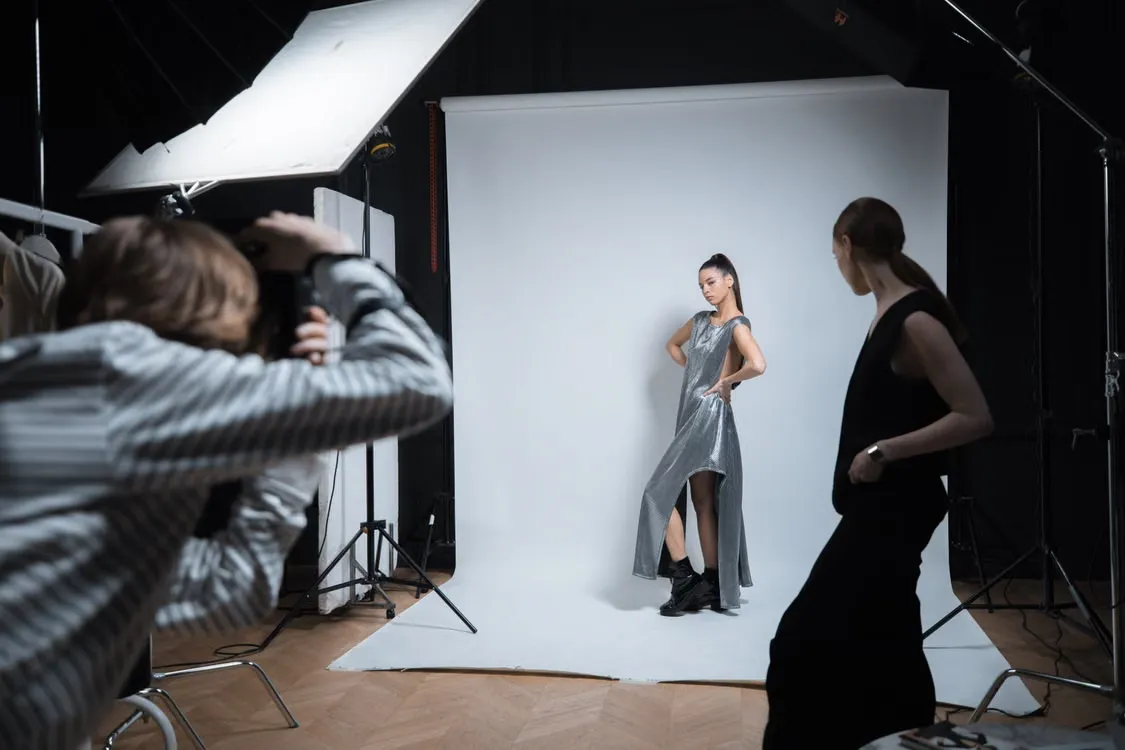
On-model apparel and lifestyle photography requires significantly more. A typical on-model setup with a full seamless backdrop, three-point lighting, and space for a stylist and the photographer to work simultaneously needs 600 square feet or more. Lifestyle scene construction for furniture, home goods, or branded environments can require considerably larger footprints.
Beyond the shooting area, the studio needs storage for backdrops, props, equipment cases, and product samples. Without adequate storage, the shooting area becomes cluttered, setups take longer to build, and equipment gets damaged.
In urban markets, commercial space with the right specifications is expensive. Ceiling height matters for overhead lighting rigs. Natural light access matters for certain photography styles. Loading access matters for large product deliveries. A space that looks adequate for a test shoot will feel cramped once full production is underway.
Equipment Investment
A professional studio setup requires more than a camera and a lightbox. The core equipment categories and their purposes:
Cameras and lenses. A professional-grade DSLR or mirrorless body with manual controls and a full-frame sensor is the standard. Lenses required cover multiple purposes: a 50mm or 85mm prime for clean product shots, a macro lens for jewelry and detail work, and a 24-70mm zoom for lifestyle and model work. Each category of photography has different optical requirements.
Lighting systems. Strobe lighting provides the power and consistency required for catalog and marketplace photography. Continuous LED lighting suits video and is increasingly used for still photography. Softboxes, umbrellas, reflectors, and diffusers shape and control light. A lightbox is essential for small reflective products. The number of lighting setups required grows with product category diversity.
Support equipment. Tripods and light stands. Seamless paper and fabric backdrops in multiple colors. Backdrop stands and ceiling rails for quick changes. Shooting tables for tabletop photography. Motorized turntables for 360-degree product photography. A mannequin system for ghost mannequin apparel work, covering men's, women's, and children's sizing.
Post-production infrastructure. A calibrated large-screen monitor is essential for accurate color work. A powerful computer running Capture One, Adobe Lightroom, or Photoshop. Tethering cables and software for real-time review during shoots. Structured file storage and backup systems.
The initial outfitting of a professional studio runs into six figures when all categories are included. Equipment requires regular maintenance and periodic upgrades. Camera sensors need cleaning. Lighting systems need bulb replacements and recalibration. Turntables and rigs need servicing.
For a complete breakdown of equipment choices across product photography categories: Product Photography Equipment: The Complete Gear Guide
Staffing Structure
A studio is only as capable as the team running it. The roles required depend on the production volume and content types, but a fully operational in-house studio covering catalog, lifestyle, and apparel photography typically requires:
Photographer. The core technical role. Product, lifestyle, and on-model photography each require different skills and experience. A photographer who excels at tabletop jewelry work may not have the model direction experience needed for apparel campaigns. Brands producing content across multiple categories often need more than one photographer or a photographer with genuine breadth.
Retoucher. Post-production is a separate discipline from photography. A retoucher responsible for color correction, background cleanup, and catalog consistency across hundreds of SKUs needs specialist skills and significant time. Many brands underestimate the volume of retouching work that professional-quality output requires.
Stylist. For apparel, accessories, and lifestyle photography, a stylist prepares and presents products in a way that the photographer cannot do simultaneously. Garments need steaming, pinning, and positioning. Props need sourcing and arrangement. Without a stylist, shoot days run longer and output quality suffers.
Producer or studio coordinator. Someone needs to manage the schedule, coordinate product deliveries, brief the team, and maintain the workflow between shoots, retouching, and delivery. In smaller studios this role is absorbed by the photographer or a marketing team member, but the work still exists and takes significant time.
Set designer. For lifestyle and campaign photography, a set designer builds the environments that contextualise products. This is a specialist role that cannot be adequately covered by a stylist.
For how these roles function in a professional production: Understanding the eCommerce Photography Creation Process and Team Involved
Planning Your Photography Studio Setup: Where to Begin
Building an in-house photography studio for your eCommerce brand starts with meticulous planning. The decisions you make here will determine how well your studio performs, how scalable it is, and whether it delivers the ROI (return on investment) you expect. Let’s break down the essential elements of planning, supported by facts, real-world considerations, and practical tips.
How to Choose the Perfect Space for Your Studio
To create a productive environment, you’ll need to evaluate your options based on several critical factors:
Lighting Conditions
Studies show that proper lighting can reduce post-production, as better lighting minimizes the need for extensive editing. Spaces with large windows and ample natural light are ideal for certain types of photography, especially lifestyle shoots. However, natural light can be inconsistent, varying with time of day and weather conditions.
Professional artificial lighting ensures consistent results but requires careful placement and additional costs. The room’s height and dimensions must allow for optimal light diffusion.
Room Capacity
The variety of setups required for professional product photography means your studio needs to be adaptable. Even small products like jewelry might demand intricate lighting setups and multiple angles, while larger items need spacious, clutter-free zones. Props, backdrops, and delicate equipment need organized storage to avoid damage and delays. Investing in the right space from the outset saves you from costly adjustments down the line.
A studio that feels adequate now might feel cramped as your business grows, requiring costly relocation or renovation. A typical product photography setup requires at least 2000–400 square feet of dedicated space, while on-model setups can demand 600 square feet or more.
Accessibility and Location
Equipment, products, and team members need to move in and out of the studio efficiently. The studio should ideally be close to your warehouse, marketing team, or product designers to facilitate collaboration. A well-placed studio near your fulfillment center can speed up the production-to-launch timeline by reducing transit times for products.
Studio Layouts for Different Shoot Types
Different product categories require fundamentally different physical setups.
Catalog and product photography for small items like jewelry, cosmetics, and accessories requires a dedicated tabletop area with controlled lighting and a lightbox or diffusion tent. The shooting area needs to be clean, stable, and free of vibration.

Apparel photography using ghost mannequin or flat lay requires a backdrop system, adjustable mannequins, and lighting that renders fabric texture accurately. On-model apparel photography requires a spacious shooting area with a full seamless backdrop, space for the model to move, and room for the stylist to make adjustments between frames.
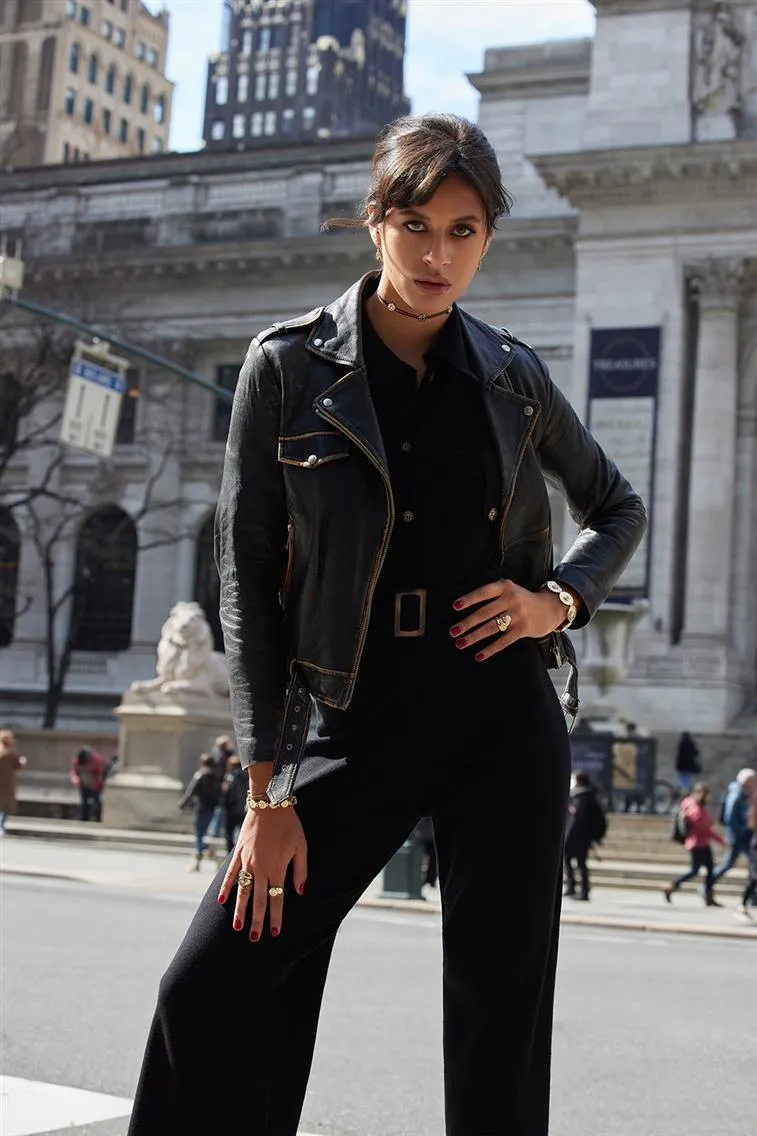
On-model catalog photography showcases apparel fit, movement, and real-life appeal. It requires a spacious shooting area with a seamless white or neutral backdrop and consistent three-point or continuous lighting to highlight garments while minimizing shadows.

Lifestyle photography requires scene construction. Photographing a sofa means building a room. Photographing a coffee maker means constructing a kitchen counter context. The equipment and spatial requirements for lifestyle photography are significantly greater than for catalog work, and the setup and breakdown time per shot is considerably longer.
360-degree photography requires motorized turntables, uniform lighting that maintains consistency through a full rotation, and post-production infrastructure for sequence assembly.
An efficient studio design uses modular equipment where possible. Rolling backdrops, mobile lighting stands, and adjustable shooting tables allow faster transitions between setups. Without modularity, transitioning between product categories burns significant time.
For how different shoot types serve different platforms and channels: How Many Product Photos Do You Really Need for Your Product Pages?
Estimating the Real Costs of Studio Setup
Here’s a detailed look at where your money will go when setting up and running a professional photography studio:
Space Rental and Renovation Costs
Renting commercial space for a studio varies widely based on location and size, while renovations should include smooth pure white walls, floor and ceiling, so no colored hue would reflect on the images. This can significantly increase the initial investment.
Equipment Costs
A professional studio setup requires cameras, high-quality lenses, lighting systems like softboxes or strobes, a variety of props and backdrops, and a powerful computer with editing software. These expenses collectively account for a substantial portion of the budget, especially when factoring in regular upgrades and maintenance.
Staffing Costs
Running a studio requires skilled professionals, including photographers, retouchers, set designers, and stylists. Salaries or project fees for these roles add up quickly, along with additional expenses like payroll taxes, Medicare, and benefits for full-time staff.
Utilities and Operational Expenses
Studios consume a significant amount of electricity due to lighting and computer equipment. Operational costs also include insurance for equipment and liability coverage, as well as ongoing subscriptions for software tools.
Recruitment and Training Costs
Finding and hiring skilled talent for specialized shoots can be expensive, particularly for occasional campaigns like lifestyle or 360-degree photography. Continuous training is also necessary to keep the team updated on the latest tools and techniques, ensuring competitive output quality.
These costs collectively represent a substantial financial commitment, often exceeding initial expectations, particularly as the studio grows or scales to meet new demands.
Essential Equipment for a Professional Photography Studio Setup
Must-Have Tools for High-Quality Photography
The foundation of any photography studio lies in its core equipment like cameras, lenses, and lighting.
Cameras: A professional-grade DSLR or mirrorless camera is indispensable for capturing high-resolution, detailed images. These cameras offer manual controls, interchangeable lenses, and advanced sensor technology to adapt to various lighting conditions and shooting needs.
Lenses: Different types of lenses are required to cover a range of photography styles. Fixed focal lengths like 50mm or 85mm work for sharp, distortion-free shots. Versatile options like 24-70mm are good for flexibility in framing and angles. Macro lenses are irreplaceable for capturing fine details in small products like jewelry or watches.
Lighting Essentials: Consistent, professional lighting is critical for any studio. Common options include:
- Softboxes and Umbrellas for diffused lighting that eliminates harsh shadows.
- Strobes and Continuous Lights provide flexibility for both still photography and video content.
- Reflectors and Diffusers to control and soften light, ensuring balanced exposure.
- Lightboxes are particularly useful for small-to-medium products, offering even, controlled lighting for items like accessories, cosmetics, or electronics. Compact and versatile, it reduces the need for extensive post-production adjustments.
Table Computer with a Large Screen: A powerful computer with a calibrated large screen ensures accurate color reproduction during tethered shooting and post-production. Software like Capture One or Adobe Lightroom enhances the ability to edit in real time, reducing workflow bottlenecks.
Setting Up for Different Shoots with Backdrops and Props
A versatile studio must accommodate a range of eCommerce photography styles, which requires adaptable backdrops and a well-stocked collection of props. Interchangeable backdrops provide flexibility for different product categories. Seamless paper or fabric backdrops are common for catalog shots, offering clean, uniform backgrounds in white, gray, or brand-specific colors. Textured backdrops add depth and character, ideal for lifestyle shoots or premium products. Chroma Key (Green Screen) is used for more advanced editing and compositing.
Props are essential for creating context and enhancing product presentation. These can include furniture and decor for lifestyle scenes, neutral stands or blocks to elevate products for a better perspective, contextual props like utensils for kitchenware or flowers, velvet fabrics, and rocks for luxury goods.
A professional set designer in a studio ensures backdrops and props align with a shooting aesthetic. They craft visually appealing layouts that enhance product focus without distracting from key details. For example, a set designer might arrange complementary tones and textures for a handbag shoot, ensuring the product stands out while maintaining an on-brand atmosphere.
Related Read: What Is Set Design and Why Your eCommerce Photography Needs a Set Designer
How to Keep Things Up-to-Date to Match Professional Visual Content Standards
Professional equipment requires regular servicing to maintain precision and reliability. Camera sensors need periodic cleaning, lighting systems demand replacement bulbs, and turntables or rigs must be recalibrated for accuracy. Additionally, staying competitive often means upgrading to newer technology, which involves significant reinvestment.
Outfitting a professional studio is a continuous commitment. The initial investment runs into six figures, covering essential equipment, backdrops, and specialized tools. Over time, maintaining and upgrading these assets adds to operational costs. However, this investment is what ensures a studio's ability to produce consistent, high-quality visuals that meet the demands of eCommerce photography.
Challenges of Managing an In-House Photography Studio
Workflow Challenges
The operational challenges of running an in-house studio are where many brands discover the gap between their expectations and reality.
Scheduling complexity. A studio running multiple product categories across marketing, eCommerce, and wholesale needs serves competing deadlines simultaneously. A seasonal campaign requiring immediate attention disrupts the regular catalog schedule. Products arriving late or with defects force reschedules. Approvals on shoot plans or final images create bottlenecks. Without a producer managing the schedule, these conflicts compound.
Product preparation. Products need to be cleaned, inspected, and prepared before every shoot. Apparel requires steaming and pinning. Jewelry needs polishing. Packaging needs to arrive undamaged. For high-volume shoots covering dozens or hundreds of SKUs, product preparation is a significant logistical operation in its own right.
For how to manage product preparation efficiently: Preparing Your Products for a Photoshoot
Post-production volume. A full day of catalog shooting generates a substantial retouching workload. Without dedicated retouching capacity, images back up and delivery timelines extend. Without standardized retouching guidelines, quality varies across the catalog. Both problems are harder to solve than they appear before production begins.
Consistency over time. Maintaining visual consistency across shoots produced weeks or months apart requires documented setup standards, consistent equipment, and stable team composition. Personnel changes, equipment upgrades, and evolving brand guidelines all introduce variation that is visible in the catalog and difficult to correct retroactively.
Space Capacity and Team Skills Gaps: Key Limitations
The physical and human resources of a studio directly affect its output. When these are inadequate, production slows down, and quality suffers.
Space Constraints
- Limited Room for Setups: A lack of space means constantly tearing down and rebuilding setups, which wastes time and risks inconsistencies.
- Storage Issues: Props, backdrops, and equipment need proper storage. Cluttered or cramped conditions lead to inefficiency and damage to expensive tools.
- Multi-Use Limitations: Studios often struggle to handle simultaneous shoots for different product categories, such as a lifestyle scene requiring furniture props and a tabletop shoot for jewelry.
Team Skills Gaps
- Specialization Challenges: Not all photographers or stylists excel in every type of shoot. A photographer skilled in flat-lay product images may lack the expertise needed for model or lifestyle shoots.
- Lack of Cross-Training: Without cross-training, team members may struggle to step into other roles when someone is unavailable. For instance, a retoucher unable to handle editing for both jewelry and apparel creates delays.
- Understaffing: Many businesses underestimate the size of the team required, leaving critical roles like set designers or lighting technicians unfilled.
Expanding space or hiring additional talent involves significant costs. Even when budgets allow, finding and retaining highly skilled professionals in specialized roles is challenging. If you want to know more about the professionals involved in the e-commerce visual content creation process, read our article.
Maintaining Consistency and Quality Across Shoots and Retouching
Consistency is one of the most underestimated yet critical aspects of professional photography. For eCommerce, where hundreds or thousands of images are displayed together, any variation in quality stands out and diminishes brand credibility.
Consistency Across Shoots
Without a consistent lighting setup, products shot on different days may look noticeably different, even within the same category. Changes in team members, props, or backdrops can lead to subtle but noticeable shifts in the visual style over time. Slight differences in camera height or angles create inconsistencies that distract customers and reduce the professional appeal of the catalog.
Retouching Challenges
Without strict guidelines, retouchers may interpret edits differently, leading to uneven quality. Achieving true-to-life colors is especially challenging for apparel, cosmetics, or products with reflective surfaces. High-volume projects often stretch retouching resources, increasing the likelihood of rushed or subpar edits.
Want to learn more about the impact of retouching in eCommerce? Read our article on ‘The Impact of Product Photography Retouching on Online Sales’.
Brand Aesthetic Alignment
When marketing, product, and creative teams all have input, aligning on a cohesive aesthetic becomes complex. As brands grow or rebrand, maintaining alignment with new guidelines can be difficult, especially when older team members or assets remain in circulation.
Maintaining consistency and quality requires detailed documentation, rigorous training, and continuous oversight, all of which demand time, money, and expertise. Without these safeguards, inconsistencies quickly creep in, affecting the overall brand image.
True Costs and ROI
The financial case for an in-house studio needs to account for all costs, not just the visible ones.
Direct costs include space rental or purchase, initial equipment investment, ongoing equipment maintenance and upgrades, software subscriptions, and utility costs for high-powered lighting systems.
Staffing costs include photographer salaries, retoucher salaries, stylist fees, producer costs, payroll taxes, benefits, and recruitment. Finding and retaining skilled specialists in photography, retouching, and styling is a significant ongoing operational burden.
Hidden costs include equipment depreciation, insurance for equipment and liability, training and professional development, and the management time required to coordinate a studio operation alongside other business functions.
ROI calculation methodology. Divide the total monthly cost of running the studio by the number of finished images delivered per month. Include all salary, overhead, equipment, and operational costs. Compare the resulting per-image cost against the rates of professional studios for equivalent work. This comparison needs to account for consistency and quality guarantees, not just headline cost per image.
For most brands, the economics of in-house production become favorable only at sustained high volumes with stable, experienced teams. At lower volumes, or during the startup period when the team is still developing its workflow, outsourcing typically delivers better quality at lower effective cost.
The Build vs Outsource Decision
The decision is not binary. Many brands use a hybrid approach: in-house production for routine catalog work where volume justifies the investment, and outsourced production for campaigns, launches, and categories requiring specialist skills or equipment the in-house studio does not have.
The clearest signal that in-house production makes sense is sustained, predictable volume with consistent product categories. The clearest signal that outsourcing makes sense is variable volume, diverse product categories, or a business that has not yet reached the scale where the fixed costs of studio operation are justified by the per-image economics.
For how to evaluate and choose a professional photography studio read: How to Choose an eCommerce Photography Studio