


The Modern eCommerce Brand’s Guide to Jewelry Photography: Boost Sales with The Right Visuals
Jewelry is one of the most technically demanding categories in eCommerce photography, and at the same time, jewelry purchases are almost entirely visual.
This guide covers the main photography types used for eCommerce jewelry, the platform and retailer requirements that determine what images you need, and how to use photography across your online store, social media, and offline marketing.
Part of our complete guide: The Ultimate Guide to eCommerce Product Photography
Jewelry eCommerce Catalog Photography: On-White, Off-White, and Open Light
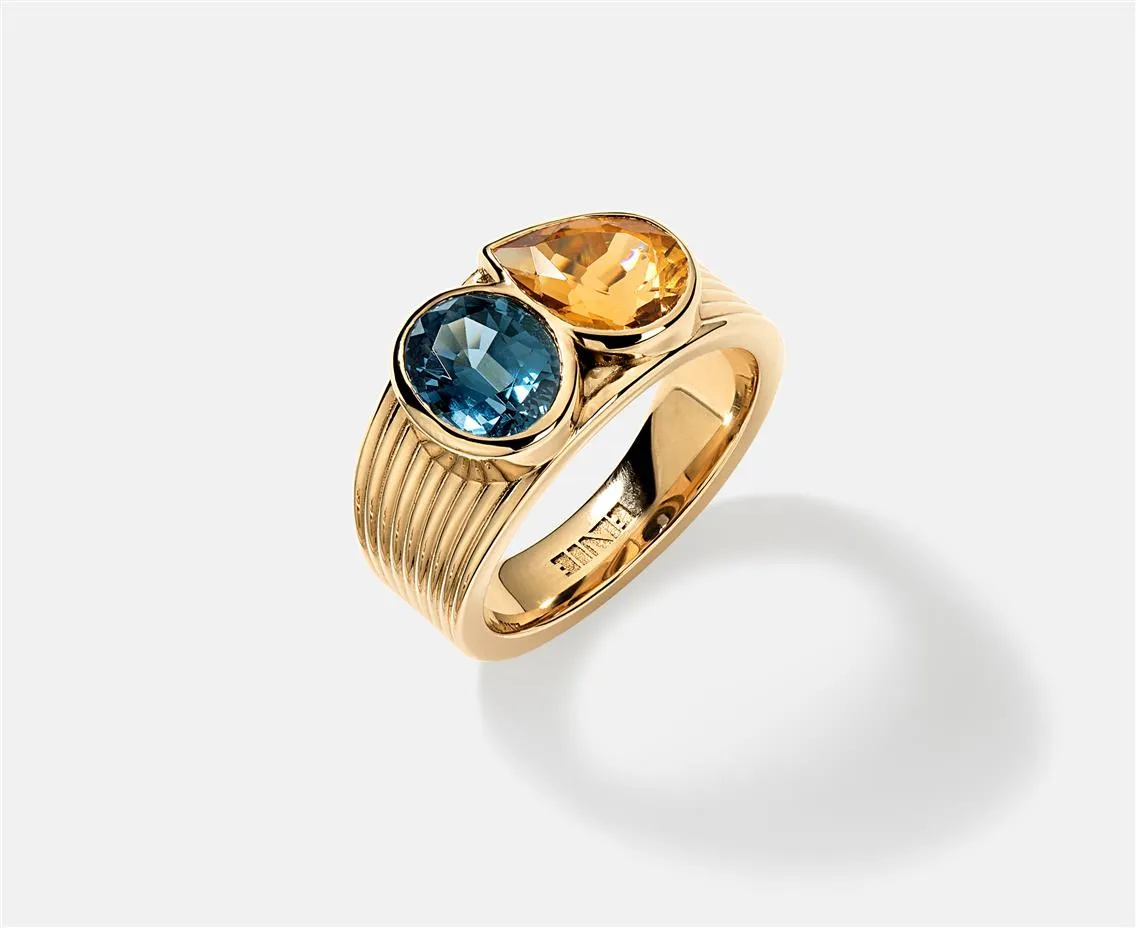
On-white photography
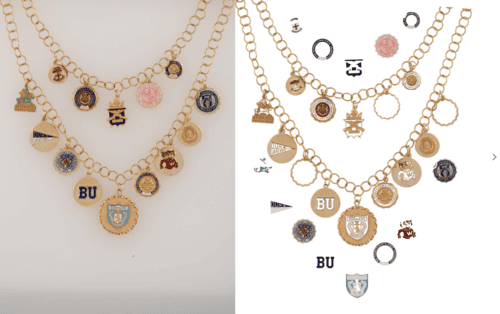
On-white photography places jewelry against a pure white background, typically achieved through a lightbox setup or post-production background replacement. Amazon requires the main product image to be on a pure white background at RGB 255,255,255. Most major US jewelry retailers — Signet, Kohl's, Macy's, JCPenney, Helzberg, Fred Meyer, Sherwood, Zales — specify white or near-white backgrounds in their vendor guidelines.
Off-white photography
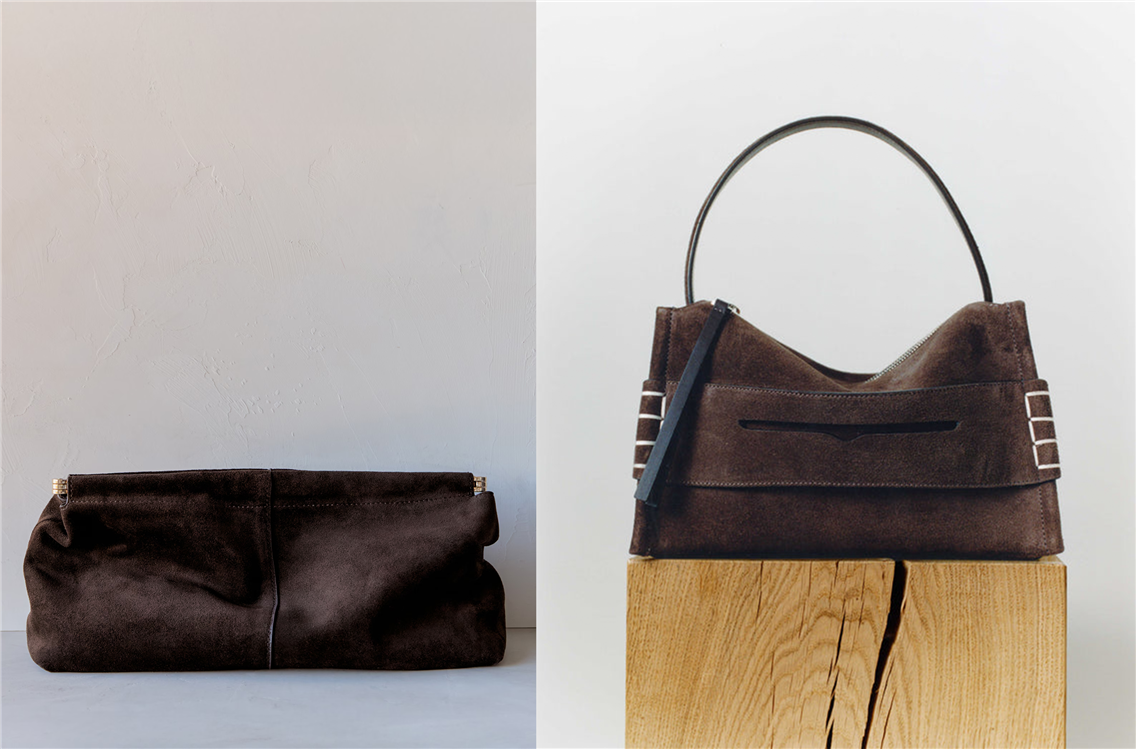
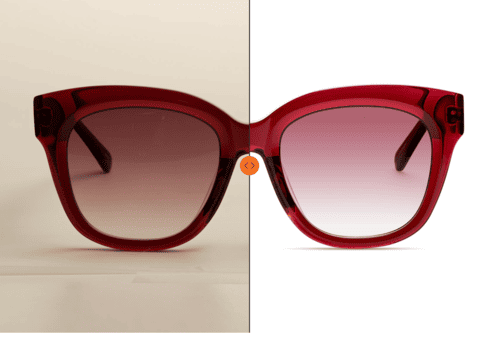
Off-white photography uses softer background tones — light cream, ivory, or pale gray — instead of pure white. The result retains the clean, minimal look that most platforms require while preserving more of the natural shadow and reflection behavior around the piece.
Off-white also creates a softer, more inviting image that feels less harsh than pure white. It’s a useful compromise for brands that want a clean aesthetic without losing the natural beauty and depth of the jewelry. This method works particularly well for high-end or artisanal pieces, where craftsmanship and material quality are essential to communicate through photography.
Open light photography
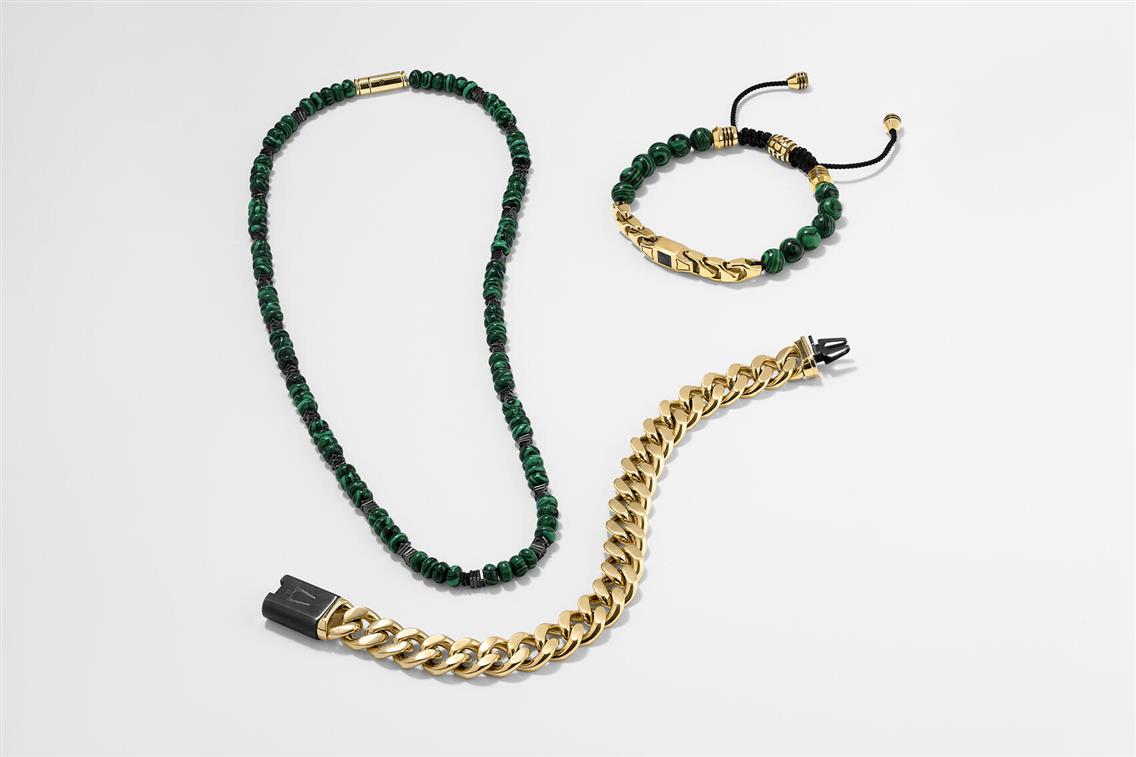
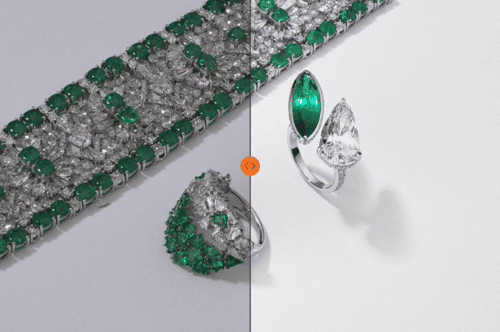
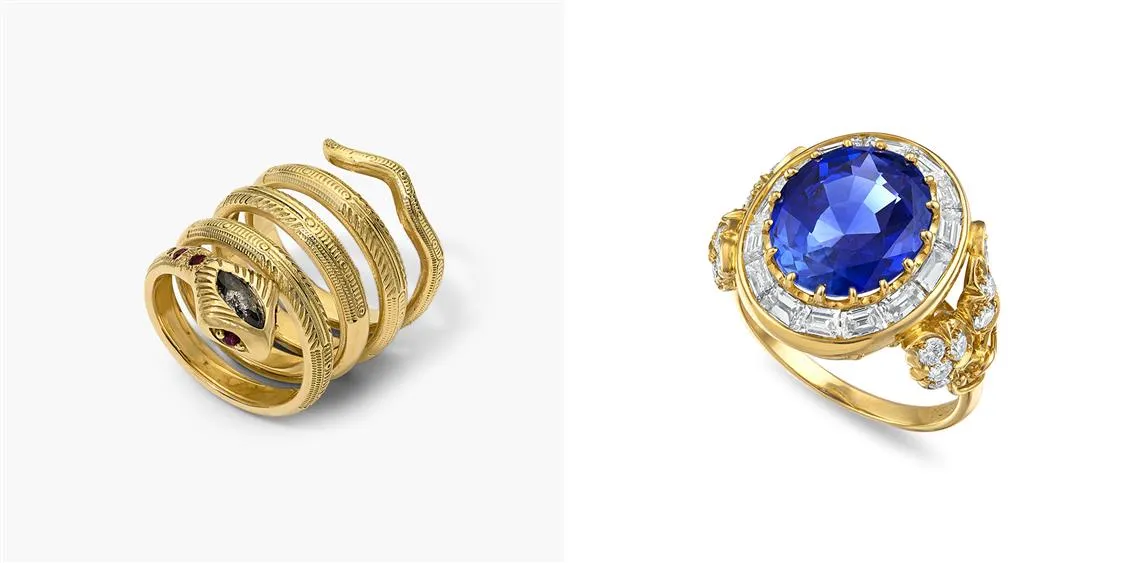
Open light photography removes the lightbox entirely. The piece is lit under controlled open studio lighting — directional, with modifiers chosen specifically for the material being photographed. The background can be white, off-white, gray, or any solid color, and the lighting setup is built around what the piece actually looks like rather than around a fixed enclosure.
The difference is visible in the output. Directional lighting creates genuine depth, shows how the metal surface actually catches light, and allows gemstone facets to refract correctly. The piece looks like an object that exists in space rather than a product floating against a white field.
Open light photography also gives brands more creative flexibility. Because the background and lighting are both variable, the same shooting session can produce images for retailer submissions, brand website, and editorial use — with the background swapped in post-production where needed. LenFlash offers background replacement as part of open light orders: you receive both the open light version and a digital white background version from a single shoot, without a separate setup.
For a complete guide to open light technique including when to use it and how it compares to lightbox: Introducing Open Light Product Photography
For the technical side of lighting setups, equipment, and how to approach reflective surfaces: Jewelry Photography Techniques Guide
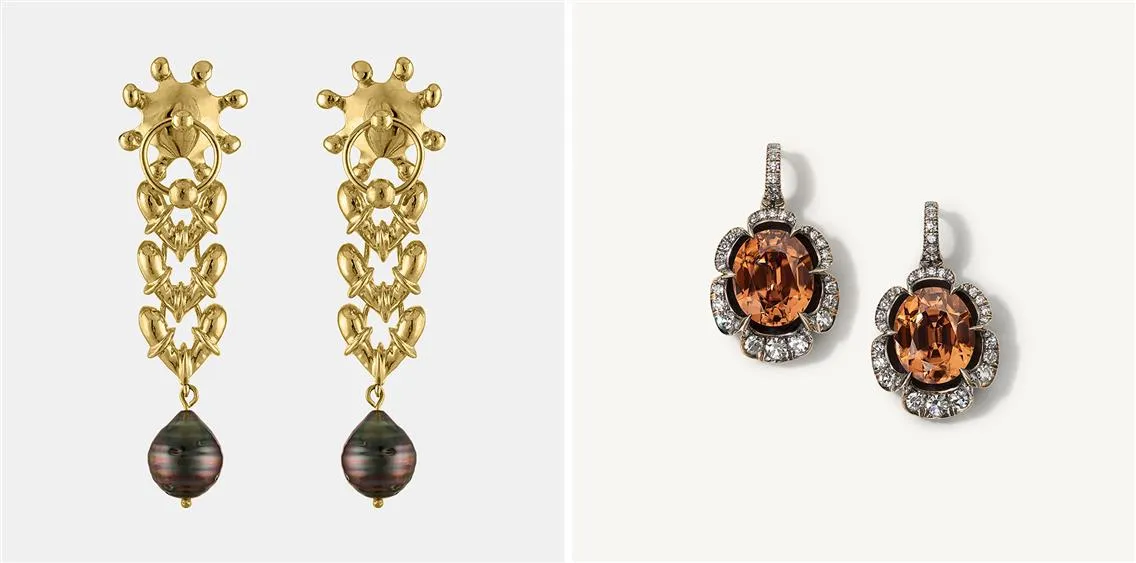
Still life jewelry photography
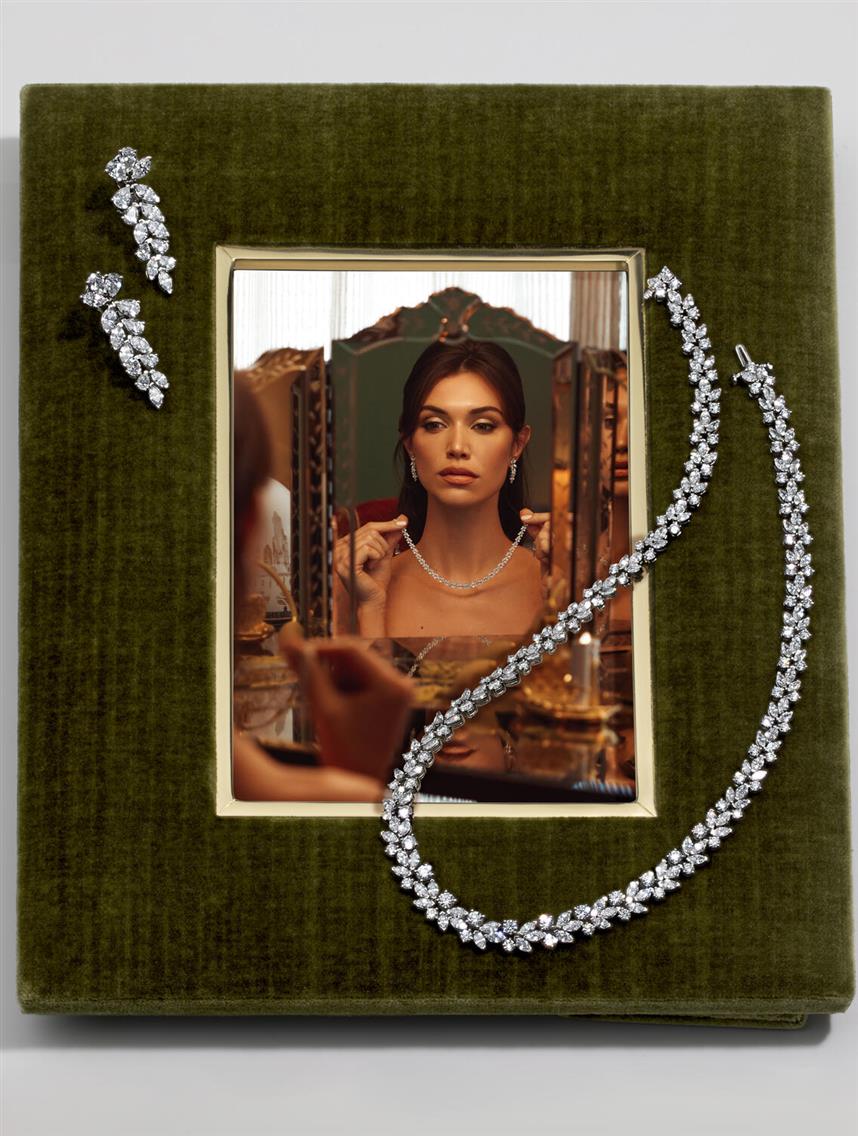
Still life photography places jewelry in a composed setting with props, textures, and surfaces chosen to support the piece's story. The goal is not to show the jewelry in use but to create a visual context that communicates the brand's aesthetic and the piece's character.
The elements in a still life — fabrics, surfaces, secondary objects — should serve the jewelry without competing with it. Velvet and satin work for high-end pieces; natural materials like stone or wood suit artisanal or organic aesthetics. The setup should deepen the impression of the piece rather than distract from it.
Still life photography is well suited for brand pages, email campaigns, lookbooks, and social content where the objective is impression rather than specification. It works alongside catalog photography rather than replacing it — most jewelry brands need both.
For a complete guide to still life photography across product categories: How Product Still Life Photography Works for eCommerce Businesses
Lifestyle jewelry photography
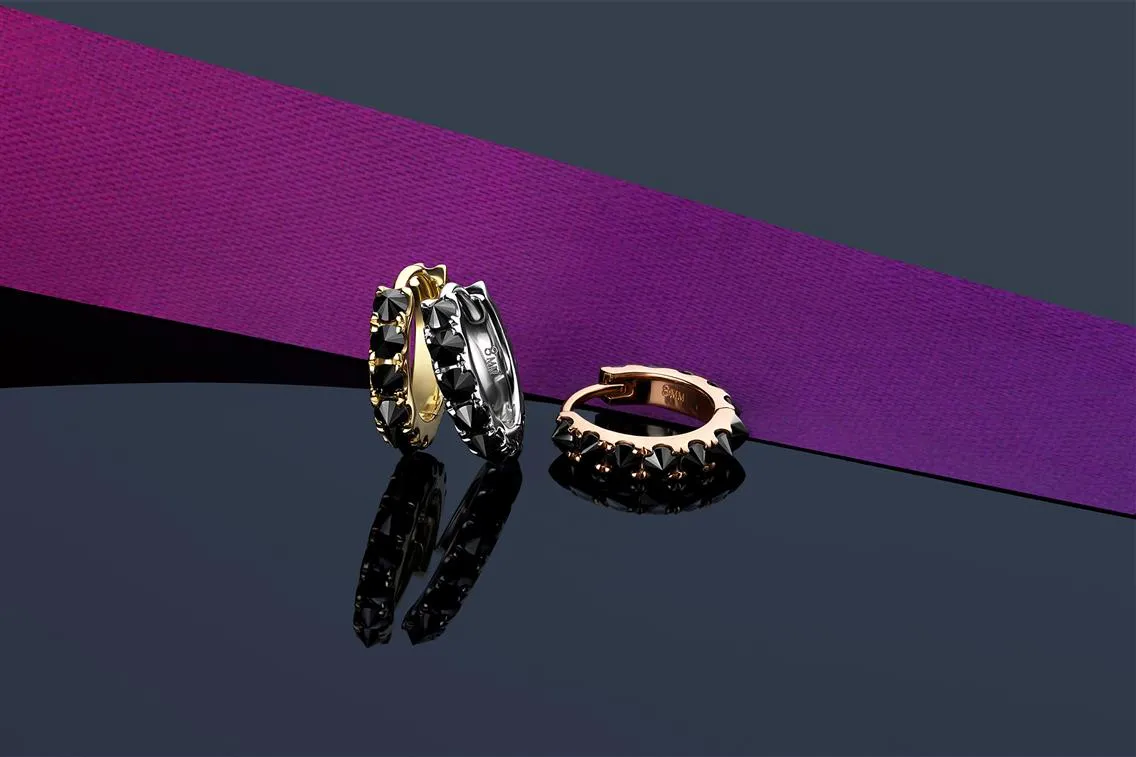
Lifestyle photography shows jewelry being worn, in real or constructed settings that reflect the brand's world. A ring on a hand at a dinner table, earrings against the backdrop of an evening event, a necklace worn during a moment that represents the brand's audience.
This style is effective because jewelry purchases are often emotionally motivated. A customer deciding between two technically similar rings is frequently making a decision about what wearing that ring says about them. Lifestyle photography gives them a version of that answer before they buy.
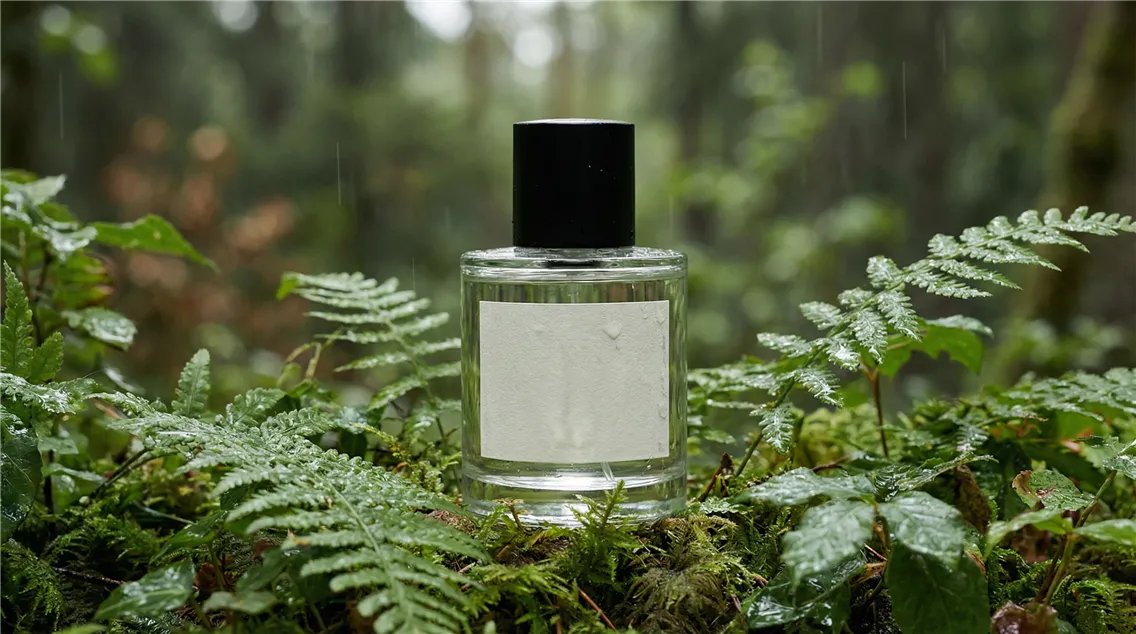
The setting of a lifestyle shoot should align specifically with the target customer's life — not a generic aspirational environment but the specific context that resonates with your audience. Urban and modern for fashion-forward brands, refined and quiet for luxury positioning, outdoor and natural for artisanal or heritage jewelry.
Lifestyle photography is the format that performs best on Instagram and Pinterest, where the visual story matters more than product specification. It is also effective for A+ Content on Amazon listings and for homepage and collection-page imagery on DTC sites.
For strategic guidance on lifestyle photography across social channels: Strategic Impact of Lifestyle Photography on eCommerce Business
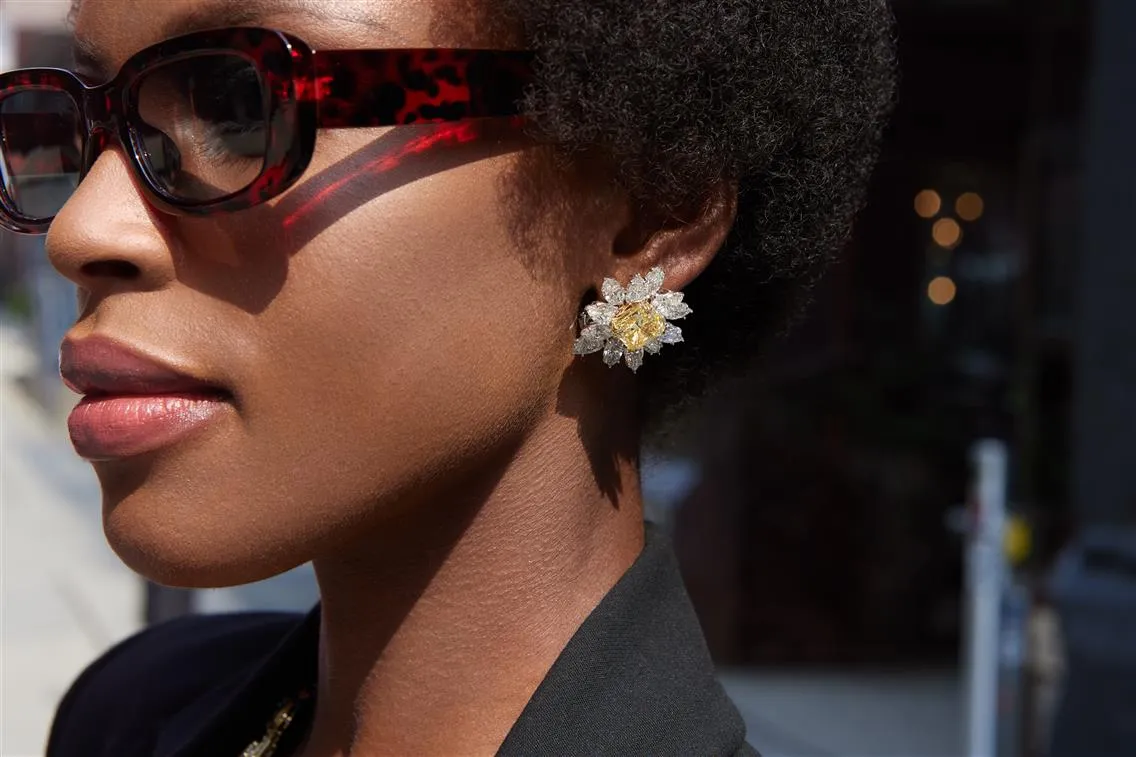
Fashion Editorial Jewelry Photography
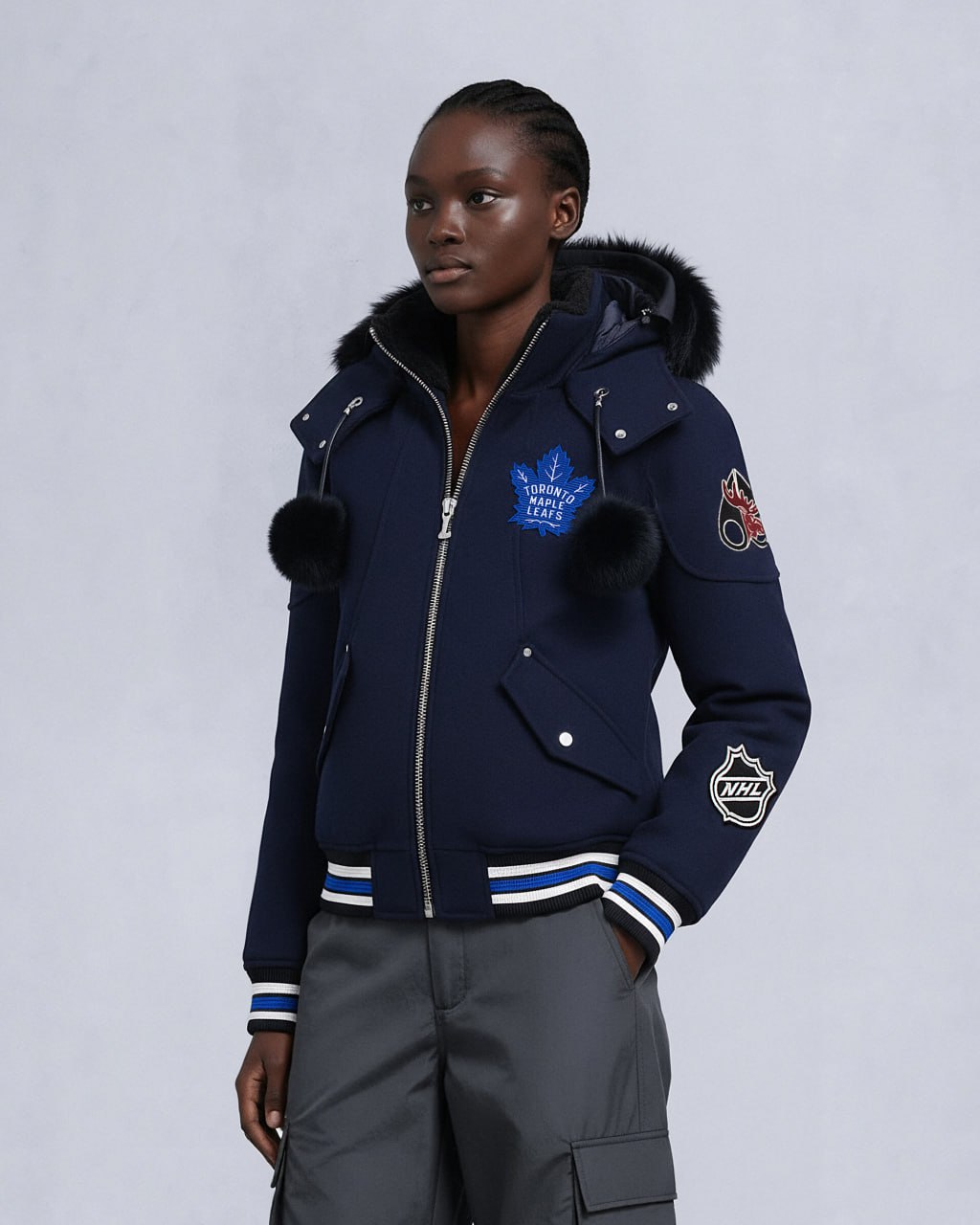
Editorial photography uses jewelry as part of a larger visual narrative. The product appears within a concept — a mood, a world, an idea — rather than as the sole subject of the frame. This style is used for marketing campaigns, brand lookbooks, press coverage, and magazine features.
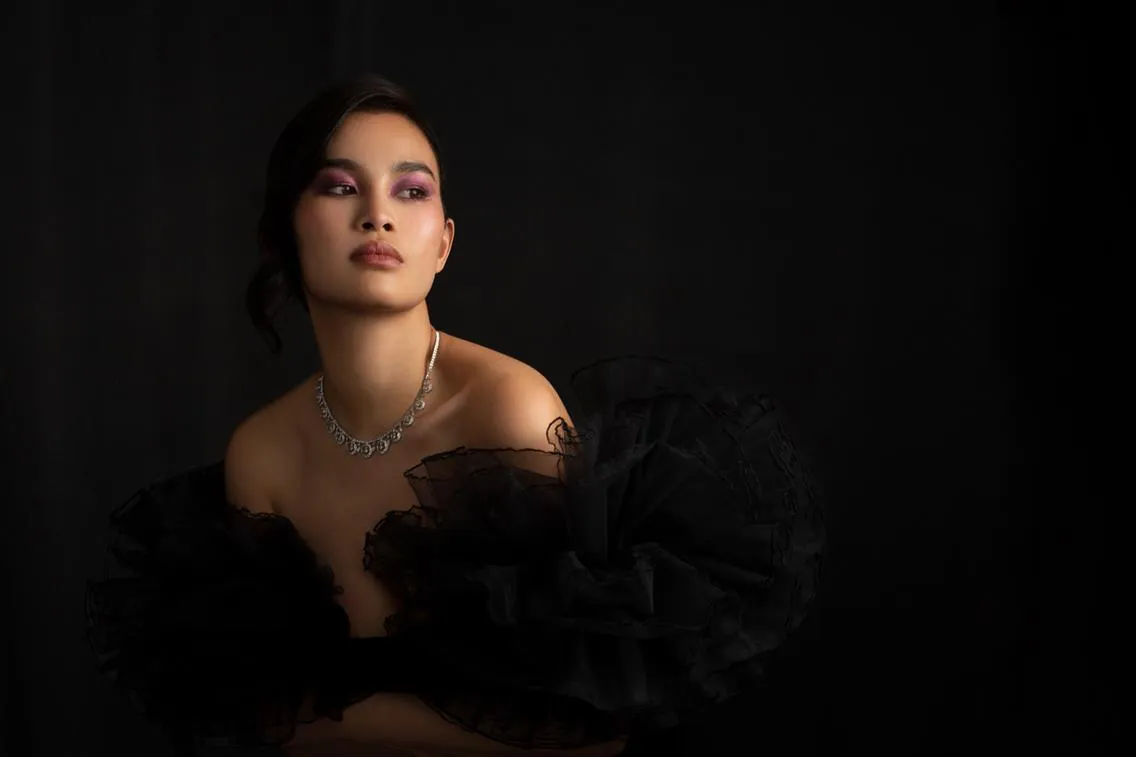
Editorial photography requires broader creative input than catalog or lifestyle work. A creative director defines the concept and mood. A stylist selects wardrobe and accessories that serve the narrative without competing with the jewelry. A makeup artist and hair stylist ensure the complete look is coherent. The photographer executes the brief within that fully defined creative framework.
The output is images that communicate brand identity at a level that catalog photography cannot reach. Where catalog photography says "this is what the product looks like," editorial photography says "this is what the brand represents."
For guidance on assembling the right team for a fashion editorial shoot:
- Art Direction Guidelines for Your Jewelry or Fashion Brand
- Why Your Brand's Next Shoot Needs a Pro Fashion Stylist
- What Does a Creative Director Do in eCommerce Photography?
- The Smart Way to Find and Choose Models for Your Brand Photoshoot
Interactive Stop-MotionJewelry Photography
Interactive stop-motion captures a jewelry piece across a full rotation — typically 24 to 36 frames — which are stitched together into an interactive 360-degree model. The viewer can rotate the piece in any direction, examine the clasp, see how the setting looks from above, and check the back of a pendant.
For jewelry specifically, this eliminates a major purchase barrier: customers buying rings, necklaces, and earrings online frequently cannot tell what a piece looks like from angles other than the hero shot. Interactive stop-motion removes that uncertainty. It is particularly effective for rings (where the band profile, setting style, and stone angle all matter) and for pieces where the back construction — a clasp mechanism, an engraving — is part of the purchase decision.
For a full guide to stop-motion production and how it works across eCommerce platforms: What Is Stop Motion Animation and How It Works in eCommerce
Platform Requirements: Amazon, Etsy, Signet, Macy's, and More
Every major marketplace and retail chain publishes image specifications. Understanding these before commissioning photography prevents the most expensive mistake in catalog production: paying for images that get rejected and have to be reshot.
Amazon
Amazon's main image requirements are strict and consistently enforced: pure white background at RGB 255,255,255, product filling at least 85 percent of the frame, no props, no text, no watermarks. JPEG or TIFF, minimum 1,000 pixels on the longest side, 1,600 pixels or more for zoom. Additional images (A+ Content) allow more creative flexibility.
Etsy
Etsy allows significantly more creative latitude than Amazon. Lifestyle images, textured backgrounds, and compositional props are all acceptable and often perform better than plain white catalog shots on the platform. Buyers on Etsy are typically looking for handcrafted or artisanal character, and photography that communicates that resonates here more than strict catalog formatting.
Major retail vendors
The vendor image requirements across major US jewelry retailers vary significantly in their specifics — background tone, angle count per product type, file format, and naming conventions all differ by chain. The retailers LenFlash regularly produces compliant imagery for include:
Signet Jewelers (Zales, Kay Jewelers, Jared), Macy's, Kohl's, JCPenney, Helzberg Diamonds, Fred Meyer Jewelers, Sherwood, and Nordstrom.
Each of these chains publishes their own vendor image guidelines, and the requirements differ enough that images produced for one chain are not always compliant for another. The angle count for rings, for example, varies between retailers — what satisfies one submission may be rejected by another. A photography studio that genuinely knows these specifications will be able to tell you exactly what is required for each chain without you having to look it up and forward the guidelines before every shoot.
For a broader overview of eCommerce marketplaces and platform options: Best Marketplaces for Your eCommerce Business Decoded
For the full breakdown of retailer-specific angle requirements and submission specs: see the retailer specification tabs in our jewelry photography ordering system
Photography For Your Own Online Store Like Shopify
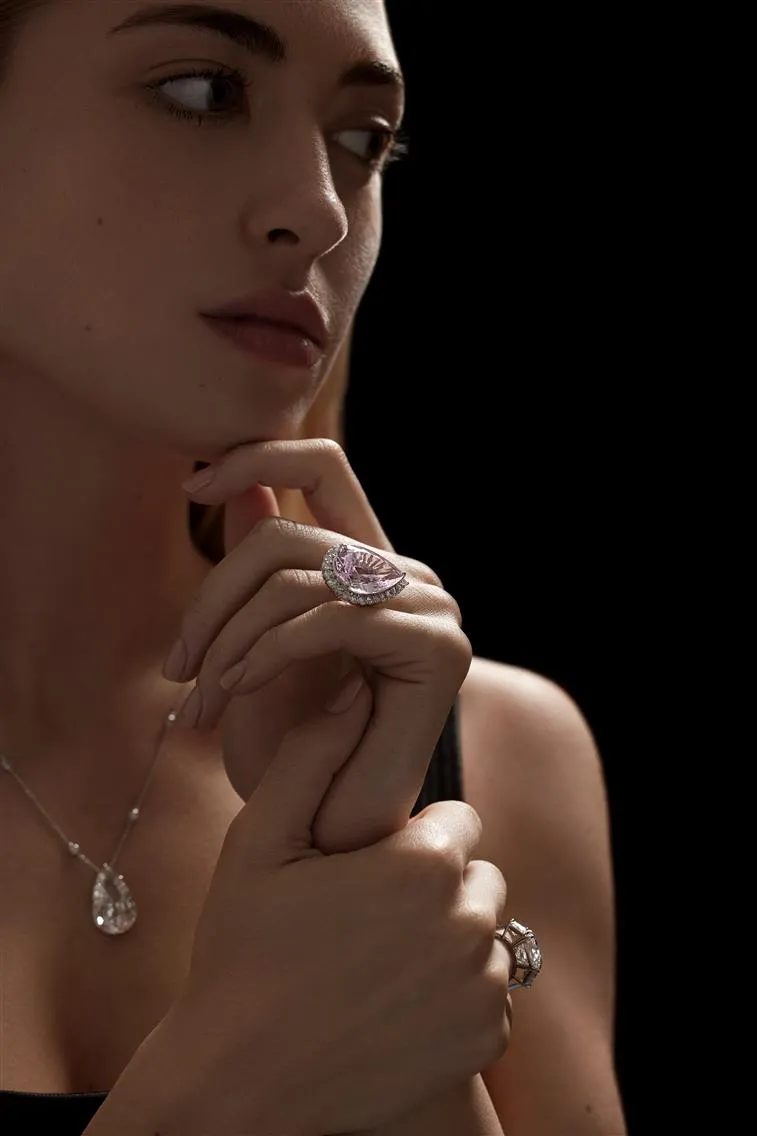
On your own website — Shopify, WooCommerce, or a custom platform — you have full control over the customer experience rather than conforming to a marketplace's rules. That freedom is only valuable if you use it deliberately.
Consistency across the catalog
Consistency in lighting, background tone, and angle conventions across every SKU in your catalog is more important than any individual image being exceptional. When a customer browses your collection and every product looks like it belongs to the same visual system, the brand reads as professional and trustworthy. When lighting varies between shoots, backgrounds shift in tone, and different products are photographed at different angles, the catalog looks assembled rather than designed — and customers register that even when they cannot articulate it.
For guidance on building and maintaining visual consistency across a growing catalog: Visual Branding for Jewelry Companies →
Accuracy over aspiration
High-quality jewelry photography on your own site should represent the product accurately — correct color temperature, preserved material texture, honest proportions. The most common photography-related return reason for jewelry is color inaccuracy: gold reads greenish under incorrect lighting, silver reads blue-toned, and gemstone colors shift under poor white balance calibration. This is a post-production and lighting problem, not a photography ambition problem. The fix is correct technique, not more retouching.
On-model and on-hand shots
For rings, necklaces, earrings, and bracelets, scale reference and wearability context matter to buyers. On-hand shots for rings and bracelets, on-neck shots for necklaces, and on-ear shots for earrings answer the questions — how large is this actually, and how does it look when worn — that purely object-based catalog photography cannot.
Shopify-specific considerations
On Shopify, image speed and SEO matter alongside presentation. Optimize file sizes for page load performance and use descriptive alt text on every image. The alt text serves both accessibility requirements and organic search indexing — a product image of a yellow gold solitaire ring should have alt text that reflects what it is, not a generic filename.
Jewelry Photography For Social Media: Instagram, Pinterest, TikTok
Social media platforms reward visual content that stops a scroll. For jewelry, the formats that perform best are lifestyle images that place the piece in an emotionally resonant context, close-up detail shots that show craftsmanship, and behind-the-scenes content that communicates the brand's authenticity.
Catalog images produced for Amazon or retailer submission almost never perform well as organic social content. The format is wrong, a white background product shot is not designed for a social feed and does not perform like content that was. Plan social media photography as a separate content type with its own brief and formatting, not as a repurposing of catalog images.
Consistency in your social feed's visual aesthetic (lighting character, color palette, compositional approach) builds brand recognition over time. Customers begin to identify your content before they see the logo, which is the outcome that drives both engagement and purchase intent.
For detailed guidance on social media content formats, aspect ratios, and platform-specific strategy: Why to Choose Lifestyle Photography for Your Brand's Social Media
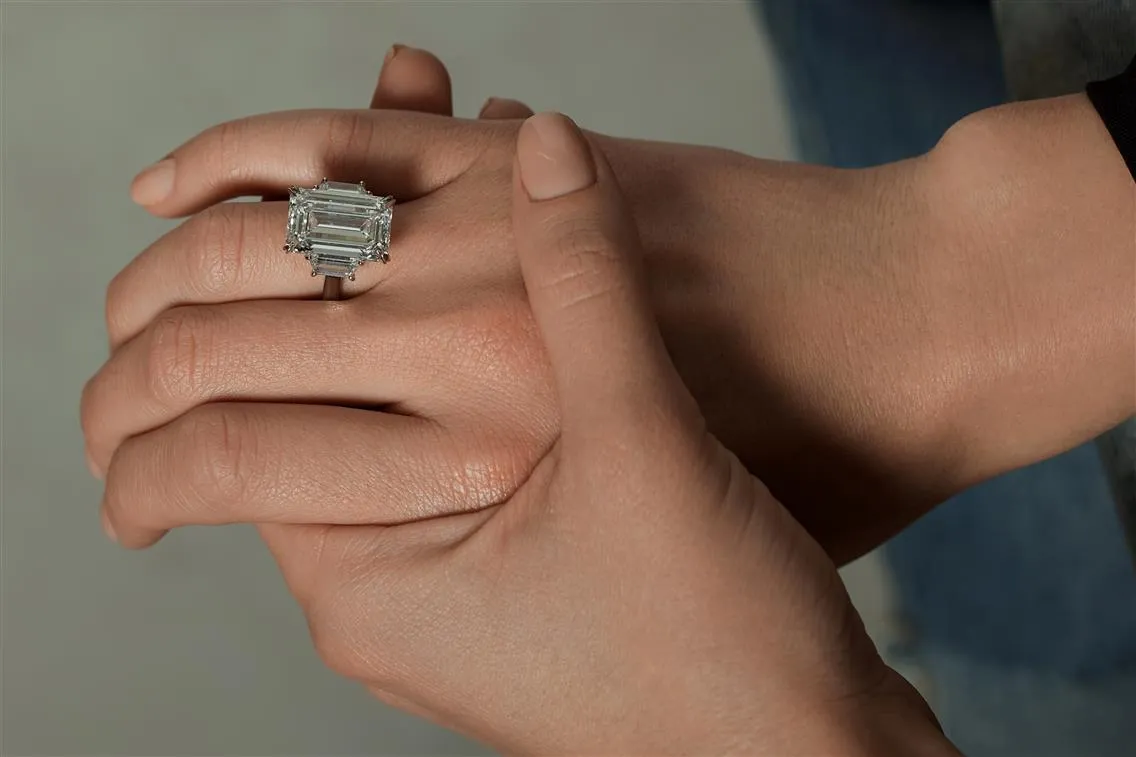
Offline And Magazine Jewelry Photography
Photography produced for print media (magazines, lookbooks, print advertising) operates under different constraints and with different objectives than eCommerce photography.
Print images are typically produced at higher resolution (300dpi minimum for print use) and with more extensive creative direction than online catalog work. The audience is reading rather than shopping, and the image has to sustain attention and create emotional impact without the context of a product page, pricing information, or a "buy now" button.
Editorial photography for magazines is rarely about showing the product clearly. It is about communicating the brand's world through a single frame. The jewelry appears as part of that world rather than as a product on display.
Producing editorial images requires a full production team working from a defined creative brief: creative director, art director, photographer, stylist, MUA, and often a set designer. The investment is higher than catalog production and the output is not optimized for platform compliance, it is optimized for brand impression.
Most jewelry brands that advertise in print maintain a clear separation between their catalog photography (optimized for platform compliance and conversion) and their editorial photography (optimized for brand impression). Both serve the brand, but they serve different parts of the customer journey.
For guidance on the full team involved in a commercial jewelry photography production: Understanding the eCommerce Photography Creation Process and Team Involved
Retouching for jewelry photography
Even well-executed jewelry photography requires post-production. Dust on metal surfaces, micro-scratches from handling, ambient reflections that appear during the shoot — all of these are cleaned up in retouching. For gemstones, retouching separates the actual facet detail from unwanted lens flare or studio reflection artifacts.
The goal of jewelry retouching is accuracy and consistency, not transformation. A retoucher who removes genuine surface texture or alters the actual color of a metal or stone produces images that generate returns. A retoucher who removes distractions while preserving material fidelity produces images that match what the customer receives.
For a complete guide to jewelry retouching technique, what the process involves, and what it costs: Jewelry and Watch Retouching Guide
LenFlash has photographed jewelry for vendors supplying Signet Jewelers, Macy's, Nordstrom, Kohl's, JCPenney, Helzberg, Amazon, QVC and other platforms from our New York studio since 2004. Online ordering, real-time quotes, no hidden costs.